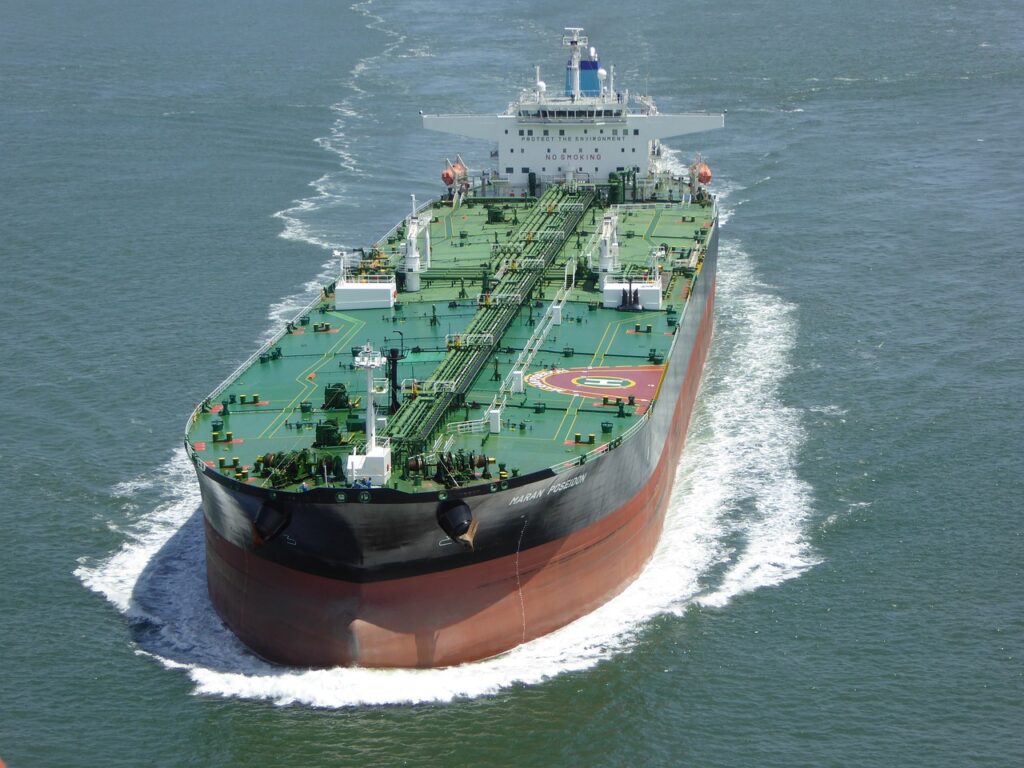
The amount of fuel an oil tanker consumes on a voyage from the Middle East to North America depends on various factors, including the size and type of the tanker, the route taken, and sea conditions. However, a rough estimate can be arrived at based on typical figures.
- Distance: The distance between major ports in the Middle East (like those in Saudi Arabia) and the Eastern Canada (like Saint John, New Brunswick) is approximately 6,000 to 7,000 nautical miles.
- Tanker Size: Large oil tankers, such as Very Large Crude Carriers (VLCCs), usually have a fuel consumption rate of around 60 to 100 metric tons of fuel per day.
- Speed: Tankers often travel at speeds of around 12 to 15 knots. The total time for the journey can range from about 20 to 30 days, depending on the exact route and speed.
Given these factors:
- Average Consumption: If a tanker consumes about 80 metric tons of fuel per day and takes around 25 days for the journey, it would use approximately 80 metric tons/day×25 days=2,000 metric tons80 \text{ metric tons/day} \times 25 \text{ days} = 2,000 \text{ metric tons}80 metric tons/day×25 days=2,000 metric tons of fuel.
This is a rough estimate, and actual fuel consumption can vary.
In 2023, the number of oil tankers sailing from the Middle East to Canada specifically isn’t typically reported in detail in publicly available data. However, we can infer some details based on broader trade statistics and patterns:
- Canada’s Oil Imports: Canada imports crude oil from various sources, including the Middle East. Other sources oil suppliers to Canada are the US, Africa, South America and Europe. The total volume of crude oil imports to Canada from international sources can help estimate the number of tankers.
- Trade Volume: In recent years, Canada’s total crude oil imports from the Middle East have been relatively modest compared to imports from other regions. For example, Canada’s total crude oil imports from all sources might be in the range of hundreds of thousands to over a million barrels per day. The Middle East’s contribution is a fraction of this total.
- Tankers and Cargoes: Large oil tankers such as VLCCs (Very Large Crude Carriers) typically carry around 2 million barrels of crude oil. Given this, the number of tankers required can be estimated based on the volume of imports.
For a rough estimate:
- Import Volume: If Canada imported around 100,000 barrels per day from the Middle East in 2023 (which is a ballpark figure), that translates to about 36.5 million barrels per year.
- Tankers Required: With each VLCC carrying roughly 2 million barrels, this would imply around 18 VLCCs per year for Middle Eastern crude imports.
The Alberta oil patch, known for its vast oil sands reserves, is a significant contributor to Canada’s oil production. As of recent data, here’s a general overview of its production capacity:
- Oil Sands Production: The Alberta oil sands, primarily located in the Athabasca, Cold Lake, and Peace River regions, are the largest contributor to Alberta’s oil production.
- Production Capacity: In recent years, production from the oil sands has been around 3.5 to 4 million barrels per day. This translates to approximately 1.3 to 1.5 billion barrels per year.
- Conventional Oil Production: Alberta also produces conventional oil, though this is a smaller portion compared to oil sands production.
- Production Capacity: Conventional oil production in Alberta has historically contributed around 500,000 to 600,000 barrels per day.
- Total Production: Combining oil sands and conventional oil, Alberta’s total crude oil production is generally in the range of 4 to 4.5 million barrels per day. Annually, this equates to roughly 1.5 to 1.6 billion barrels of crude oil.
Eastern Canada hosts several key oil processing (refining) plants. Here’s a rundown of the primary facilities:
- Irving Oil Refinery:
- Location: Saint John, New Brunswick
- Details: This is one of the largest refineries in Canada, with a capacity of approximately 320,000 barrels per day. It processes a variety of crude oils, including those imported from the U.S. and offshore.
- Ultramar Refinery:
- Location: Lévis, Quebec (near Quebec City)
- Details: This refinery, operated by Valero Energy Corporation, has a capacity of around 265,000 barrels per day. It processes a mix of crude oils and is a significant player in the eastern Canadian refining sector.
- Suncor Energy’s Montreal East Refinery:
- Location: Montreal, Quebec
- Details: Suncor’s refinery in Montreal has a capacity of approximately 137,000 barrels per day. It processes a variety of crude oils and produces a range of petroleum products.
- Esso (ExxonMobil) Refinery:
- Location: Newfoundland (Come By Chance)
- Details: This refinery has a capacity of about 130,000 barrels per day. It processes crude oil and produces various refined products.
CONCLUSION
I submit that the oil used by the tankers to transport oil from offshore is a waste.
Looking over these facts and the data, it seems that what the government of Canada is doing by importing oil from offshore it is actually increased carbon emissions from the tankers.
If there were no tankers carrying oil from some distant producer, then thre would be no carbon produced by the tankers.
Oil pipelines from Alberta would emit very little carbon.